Creatine. What it actually does, and what it doesn't.
There are supplements with impressive marketing but very little substance. Creatine is the opposite.
It's one of the most thoroughly studied substances in sports nutrition, with decades of controlled research across a wide range of people and goals. Despite this, it still occasionally gets lumped in with all the dodgy stuff, misunderstood by people who might benefit from it.
In Issue 01 of Check It Oot, I gave you the short version: what creatine is, how much to take, and why you don't need to load or cycle it. This is the longer version: the research behind it, the myths worth dropping, and how to decide if it's for you.
What creatine is, and what it does in the body
Your muscles run on a molecule called ATP. Think of it as fuel. Every contraction, every rep, every push costs ATP. The problem is your muscles can only hold enough of it for a second or two of real effort before it runs out. After that, they need to make more, fast.
Inside your muscle cells, creatine is stored in a form called phosphocreatine. When ATP runs low during strenuous effort, an enzyme called creatine kinase pulls a phosphate group off that phosphocreatine and donates it straight to ADP, which converts back into ATP almost instantly. It's a reserve tank sitting right next to the main one, ready to top it up the moment it dips. Still with me? If not, don't panic. You don't need to understand the science, just that it works.
When you supplement creatine, you increase how much phosphocreatine your muscles can hold. Depending on where your levels started, that might be an increase of somewhere between ten and forty percent above your natural baseline.1 More reserve means more capacity before the tank runs dry. That's the mechanism.
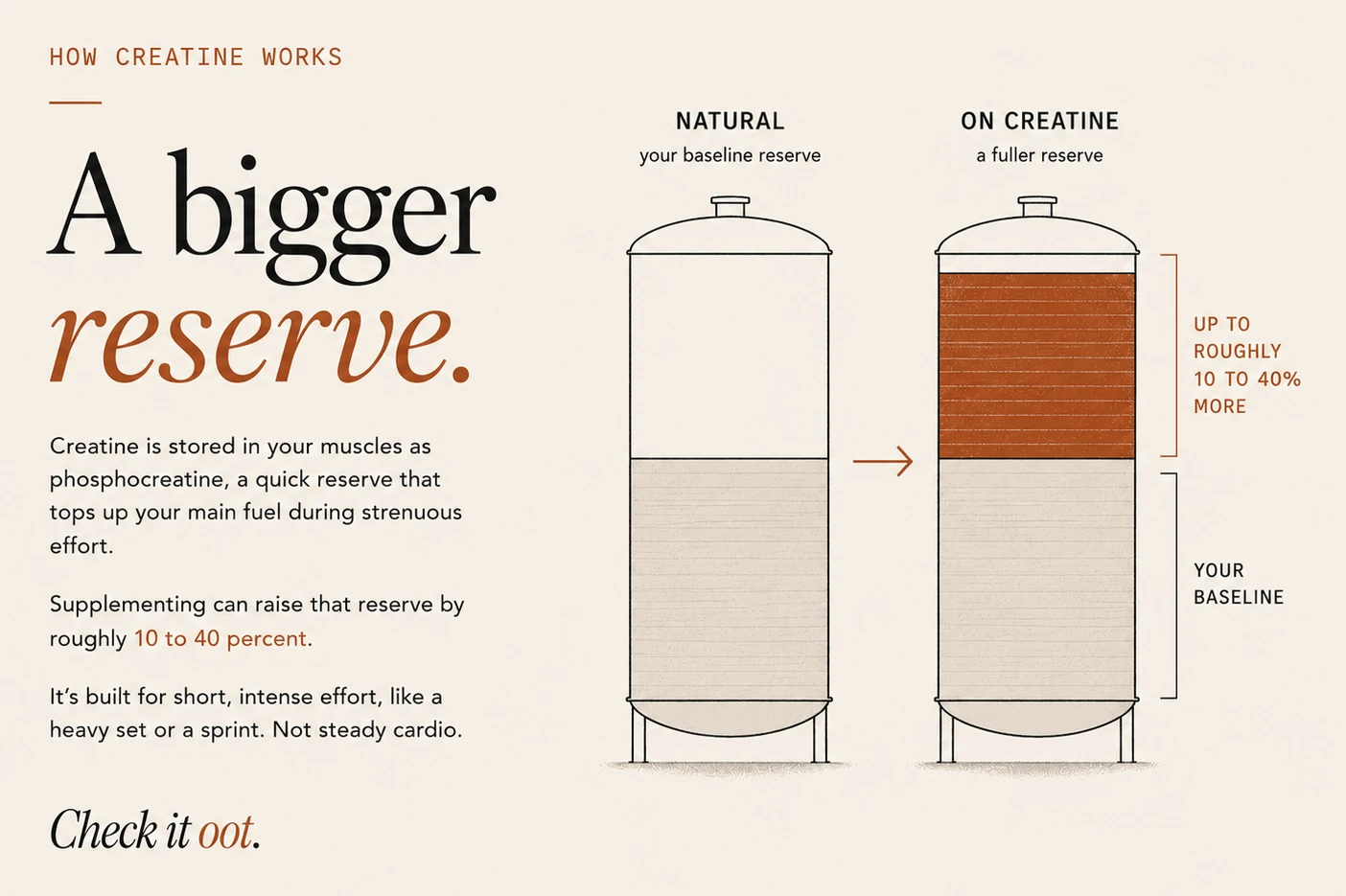
Worth saying clearly: this system is built for short, intense effort. A heavy set, a sprint, a sharp burst. It's not the energy system your body uses for long, steady cardio. If most of your training is in that zone, the benefit from creatine will be a lot smaller.
What does the research actually say?
Strength and high-intensity performance are the most thoroughly studied areas, and the evidence is solid.1 Studies across decades, covering sprinters, lifters, team sport players, and older adults preserving muscle mass, consistently show the same thing. More capacity in the energy system that powers intense effort means slightly better training output, and over time, slightly better results. Personally, anything that helps me hold onto muscle as I get older is worth trying.
There is also some evidence that creatine may support recovery after demanding exercise, although this is less settled than the performance research. If hard sessions consistently knock you sideways for days at a time, it could be worth factoring in. For most people, any effect is likely to be modest.
The brain research is where things get interesting, and where I'd urge a wee bit of patience. There are studies looking at cognitive function during sleep deprivation, at older adults, and at concussion recovery. Some of the results are encouraging. However, it's still very early days compared to the performance research, and I'd rather tell you that honestly than pretend it's a closed case.
Who is creatine for, and who can probably skip it
To be honest, creatine, like most supplements, is an optional extra. Useful, yes, but by no means a necessity. If your training, sleep, and basic nutrition aren't sorted, no supplement in the world is going to compensate for that.
That said, if those things are in order and you're doing any kind of strength or high-intensity work, creatine is one of the very few supplements where the research is genuinely excellent.
One group that tends to benefit more than others: people who don't eat meat or fish. Creatine comes naturally from those foods, so vegetarians and vegans often start with a lower baseline. The lift from supplementing can be more noticeable for them.
What about women and creatine?
Yes, women can absolutely take creatine, and the research says they benefit from it in much the same way men do: strength, high-intensity performance, and recovery.2 It's having a real moment right now, and for once the noise is worth listening to.
The main reason it might matter more for women is that they naturally carry lower creatine stores than men to begin with, and tend to eat slightly less of the meat and fish that top those stores up. So there's often more room for supplementing to make a difference.
The area drawing the most attention is menopause. As oestrogen (estrogen, if you're American and allergic to extra vowels) drops, women lose muscle and bone more quickly, and the early research suggests creatine paired with proper strength training may help slow that down. This is newer ground than the strength research, so take it as promising rather than settled, and the strongest results come when it's combined with lifting, not taken on its own. Creatine is a helper here, not a magic pill.
And to clear up the worry I hear most from women: no, it won't make you bulky, and it won't leave you bloated and puffy. That's not how it works. More on that below.
How much per day, and do you need to load it?
Three to five grams a day, every day. Consistency is the variable that matters most here, not the clock. Take it whenever you'll remember to take it.
Loading phases, where you take twenty to twenty-five grams a day for a week before dropping to a normal dose, aren't necessary. It's a bit of a hangover from the early research, and the habit has stuck. All loading does is saturate your muscles faster, in about a week rather than the three to four weeks it takes at a normal daily dose. You end up in the same place either way. At a loading dose, some people get a bit of stomach discomfort, cramping, or the odd bout of the runs. At three to five grams, those issues are much less common. I'd skip the loading and just let time do the work. Unless of course, you're in a rush.
Cycling creatine, taking breaks from it every few months, is a myth. There's no evidence it helps, and stopping just means losing the stores you've built up. So take it daily and leave it at that. If you forget a day or two, don't panic, just pick it back up when you can. It only asks for consistency, not perfection.
The common worries, answered straight
The water retention question comes up a lot, and I totally get it. Creatine does pull water in. What it doesn't do is send that water under your skin to make you look soft or puffy. It goes inside the muscle cells themselves, a process called intracellular hydration, and it's part of why creatine works. Your muscles, quite literally, drink it in. If the scale nudges up a kilo or so in the first few weeks, that's water moving into muscle, not fat sneaking on. Nothing to be concerned about.
The kidney question has been looked at extensively, and the answer for healthy people is consistently the same: creatine does not harm kidney function.3 The confusion usually comes from the fact that creatine breaks down into a compound called creatinine, which is the same marker used on blood tests to check kidney health. A slightly elevated creatinine reading when you're taking creatine isn't kidney damage. It's your body processing the supplement exactly as it should.
One honest note: if you have an existing kidney condition, it's worth speaking to your doctor before starting. Not because the supplement is dangerous in itself, but because anything that touches kidney markers is worth running past someone who knows your full picture.
The hair loss fear was one that really put me off for years. Anything that might mess with my magnificent head of hair is a hard no for me. But the entire myth traces to a single study from 2009 involving twenty rugby players. A short loading phase, a blood test, and a temporary rise in a hormone associated with hair loss in people who are genetically prone to it. They never measured anyone's actual hair. And nobody has been able to replicate even the hormone result. A randomised controlled trial published in 2025 directly measured hair follicle health in creatine users versus a placebo group over twelve weeks. No difference at all between the two groups in any hormone or any hair outcome.4 If that one's been sitting in the back of your mind, you can let it go. Pun very much intended.
My own experience, honestly
I've been taking creatine on and off for over a decade. I said this in Issue 01 and I'll say it again here: I genuinely cannot tell you if I feel it working. There's no moment where I think, that's the creatine. It's not like caffeine. No buzz, no surge, nothing I can point to and name.
And yet I keep taking it. The evidence is there, the dose is small, and the cost of being wrong is essentially nothing. Well, about ten euros a month.
I've also thought about this a fair bit. If believing a supplement is working makes you train more consistently, push a little harder in sessions, and take your recovery more seriously, does it matter whether the effect is the supplement itself or the confidence it gives you? Call it placebo if you like. Genuinely, I'm not sure it matters. The measurable percentages are so small anyway, and if the belief gets you training harder, the results are real either way.
Gummies or powder: which should you take?
Powder is the straightforward option. Pure creatine monohydrate, one ingredient, mixes into whatever you're drinking. Nothing in it but creatine. No fillers, no flavours, nothing that's not needed.
If gummies are what you'll actually take, they're fine, but choose carefully. Independent lab testing has found that a lot of creatine gummies, close to half in one recent round of checks, don't contain the dose printed on the label. So with gummies, third-party testing isn't a nice bonus, it's a necessity. If you're someone who's been buying creatine powder and then forgetting about it on a shelf, a tasty gummy might be the wee thing that keeps you consistent.
The best option is always the one you'll use. Full stop.
What I'd reach for
The simple option
Naked Creatine Monohydrate
One ingredient, no fillers, no flavours. Mixes into whatever you're drinking. It's the one I take.
Naked Creatine on Amazon →The convenient option
Biteable Creatine Gummies
5.1 grams per serving (three gummies), third-party tested with a published certificate of analysis you can check for yourself. Worth it if a tasty gummy is what keeps you consistent.
A wee note: the Naked link above is now an affiliate link, so I earn a small amount if you buy through it. Costs you nothing extra, and it's the one I actually use.
Sources
- Kreider RB, et al. International Society of Sports Nutrition position stand: safety and efficacy of creatine supplementation in exercise, sport, and medicine. Journal of the International Society of Sports Nutrition, 2017. jissn.biomedcentral.com ↩
- Smith-Ryan AE, et al. Creatine in women's health: bridging the gap from menstruation through pregnancy to menopause. Journal of the International Society of Sports Nutrition, 2025. doi.org/10.1080/15502783.2025.2502094 ↩
- Antonio J, et al. Common questions and misconceptions about creatine supplementation: what does the scientific evidence really show? Journal of the International Society of Sports Nutrition, 2021. jissn.biomedcentral.com ↩
- Lak M, et al. Does creatine cause hair loss? A 12-week randomized controlled trial. Journal of the International Society of Sports Nutrition, 2025. doi.org/10.1080/15502783.2025.2495229 ↩

Chau for now.
Martin · Barcelona