How I eat: balancing protein, carbs and fat for my goals.
A client sent me their food diary this week. Chicken breast, avocado, hummus, oats, berries. At first glance, it looked just like mine.
In real life, however, it wasn't working for them and they couldn't work out why the scales weren't moving. Nothing they were eating was wrong. Far from it. There was just far too much of it. If you're trying to lose weight, you probably don't need 120g of oats, and a banana, and berries and honey and peanut butter for breakfast. Sounds familiar? While these ingredients are rich in nutrients and extremely good for you, this portion size is perfect for an active person, not a desk worker.
That's most of what I actually do. Not big overhauls. Not clever tricks. Just working out where the extras are hiding. Written down in full like this, it's usually obvious. Without it in front of us, it rarely is. Before I suggest changing anything, I ask for a diary like theirs. A week of it, written down exactly as it happened. It's the only way to see what's really going on, rather than what someone remembers eating.
Once you've read enough of these, the same handful of mistakes keep turning up. Too many carbs, more than they actually need for what they're doing. Portions bigger than anyone realises, especially with the foods people think of as safe. Fat hiding in places that look healthy. Protein from the wrong sources. No thread running through the day, just meals with nothing connecting them.
So here's the honest version, no meal plan, no macros spreadsheet, the one that comes out of hundreds of these diaries and the conversations after them. Just how I actually think about food, for myself and for every client who asks for my help.
Three dials, and the one everyone minimises
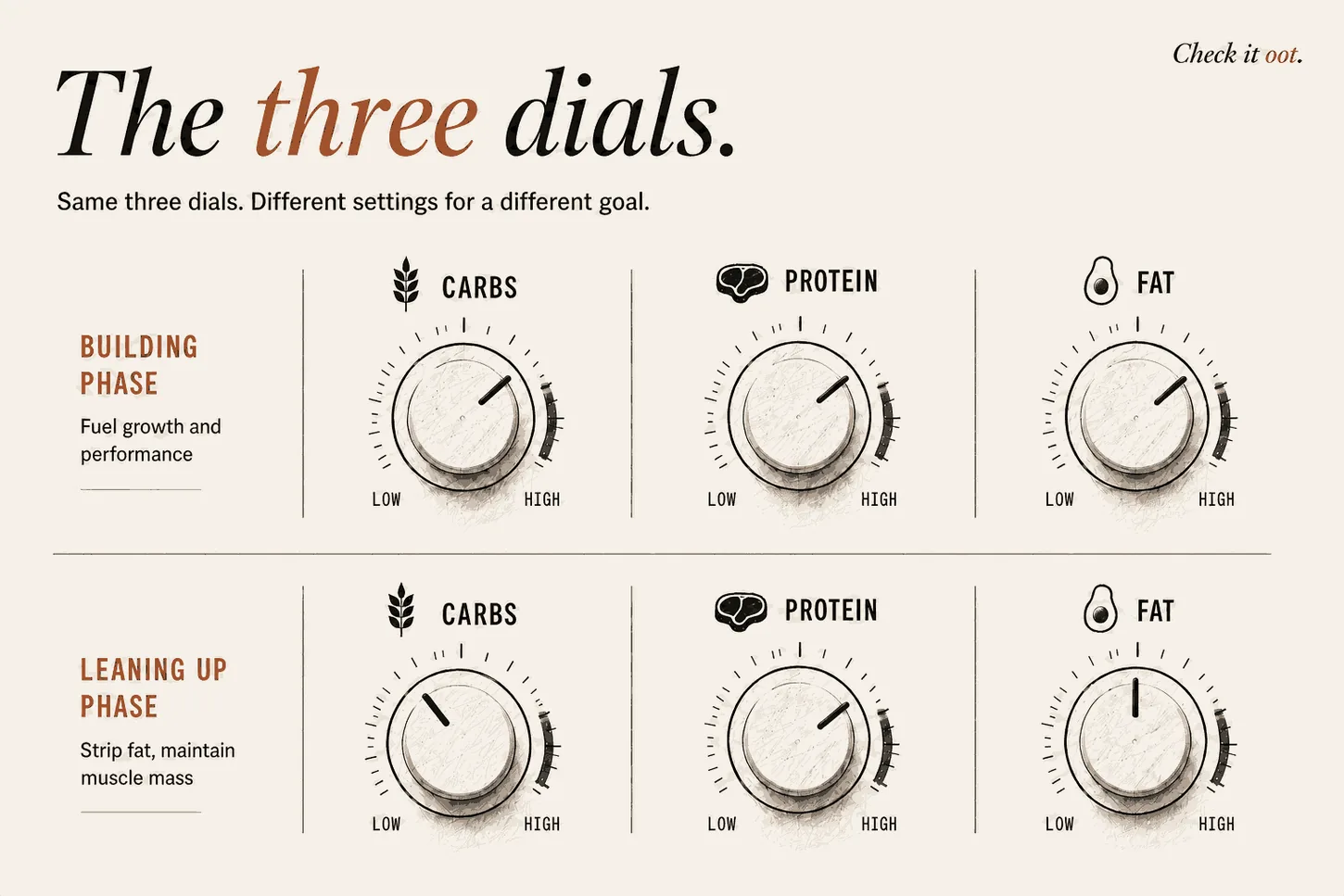
Eating well comes down to two things. What you're eating, and how much of it. The three dials handle the how much side. Carbs, protein, fat. Simple as that.
Healthy and goal appropriate are two different things, and a surplus of good food is still a surplus. Chicken, oats, olive oil, avocado, all wonderful foods. But eat enough of any of them and you can still gain weight. The quality of those calories matters enormously. It just doesn't make a surplus stop being a surplus. That's what the dials are for, not a way to judge food as good or bad, but a way of asking how much of each is right for what you're trying to do right now.
If, like me, your goals shift through the year, the dials shift with them. Heading into summer, my carbs come down and my portions get smaller too. I'll generally pull my carb portions back by around 20 to 30%. Protein and fat stay fairly steady for me year round, protein especially barely moves at all. We'll get to why shortly.
Then there's the thing that sits outside the three dials but still belongs in the picture if you drink: alcohol. I think of it the same way I think of cake. Perfect for a special occasion, great as a weekly treat if that's your thing. Far from ideal every day, and definitely not the whole cake in one sitting.
The other half of this is balance, and it works at two levels. Within a single meal, if something's already heavy in one of the three macronutrients, carbs, protein or fat, don't pile more of the same on top, turn to the others instead. I had salmon for lunch recently, lovely, but a fatty fish. So dinner that night was built around leaner protein and a mountain of vegetables, not more fat.
Balance also works across a whole day, sometimes further out than that. I'll often know what's for dinner before I've even had lunch, so I build lunch around it. If eggs are going in tonight's salad, turkey's going in today's lunch. Nothing dramatic, just a bit of thinking ahead.
That's pretty much the whole system, really. Three dials, alcohol if you drink, and a habit of looking a meal or two ahead rather than treating each one like it exists on its own.
Protein: the dial that never comes down
Whatever the goal, building or leaning up, protein stays at the higher end for me. It's not up for negotiation, and there's a good reason for that. Protein does more than build muscle. It keeps you full. It stabilises your energy. It's often the difference between feeling satisfied through the evening and raiding the biscuit tin at midnight.
For strength training clients, I generally work somewhere around 2 to 2.5 grams of protein per kilo of bodyweight a day, spread across the day rather than piled into one meal.
There are two things I see going wrong here, and amount is very much one of them. Plenty of people simply aren't eating enough protein to begin with, nowhere near the target. But even when the amount's about right, the source is just as often the problem.
The easiest way to get there is to build each meal around a clear protein source. Chicken breast, turkey, steak, tofu or whey are all straightforward options. It sounds obvious, but containing protein and being a useful way to hit your protein target aren't quite the same thing.
I hear this one constantly, from more people than you'd think: "I get my protein from nuts." I understand the logic. Nuts feel healthy. But nuts are mostly fat with a bit of protein along for the ride, and they're calorie dense enough that leaning on them for protein means eating a lot to get relatively little of what you're actually after. Nuts are great for performance, when the extra fuel and extra fat are doing you a favour. As a way to hit a protein target on their own though, they're extremely inefficient.
Beans and other legumes get reached for too, and it's worth knowing what's actually going on there. Beans are mostly carbohydrate, protein comes along as the smaller share, so hitting a real protein target from beans alone means eating through a lot of carbs to get there, the same trade off as nuts, just with carbs doing the padding instead of fat. None of that makes them bad foods. It just means knowing what else is coming along for the ride.
Vegetables are trickier still. You'd need an implausible plate of broccoli to match what one chicken breast gives you. It all counts, of course, but if I'm trying to get a decent hit of protein into a meal, broccoli isn't the thing I'm relying on to get me there.
Same story with a meal that looks high protein at a glance but is quietly carrying a lot more fat than most people would guess, chicken thigh with the skin left on, a big block of cheese alongside it. If you're properly in a building phase, that's not a problem at all. But for most people, most of the time, I'll point them towards the breast instead of the thigh, skin off, and a lighter cheese like mozzarella over a harder, fattier one. Roughly 200g of meat and 50g of cheese per serving are the numbers I tend to advise, though I don't often go gram specific unless someone asks me to.
Carbs: the lever
If protein's the constant, carbs are the lever, the dial that moves with your goal.
In a building phase, carbs go up, around training and across the day as a whole, because that's the fuel doing the actual work. Leaning up, carbs are the first thing I pull back, and portion size tends to come down with it.
For me, that usually means pulling back the added carbs first, the rice, bread or oats, rather than suddenly deciding fruit and vegetables are the problem.
It's worth saying, this isn't about fearing carbs. It's about matching the dial to what you're currently asking your body to do.
Fat: the one that adds up fast
Of the three, fat is the one I see clients overeat most, usually without realising it. Makes sense when you think about it. Fat sits at nine calories per gram, more than double the calories of carbs or protein, gram for gram, so it doesn't take much extra to tip the scales.
For me personally, fat mostly looks after itself. Olive oil, natural hummus, nuts and seeds, cheese, salmon, that's where most of mine comes from. I'll have the odd chippy when I'm home, though if I'm honest, I don't rate fried food as worth the calories. Dark chocolate is different. I'll always find room for a square or two of 90%.
For clients, it's a different story. I was chatting to one who has a chef cook for her. She'd asked him to reduce fat and add more vegetables to her meals, sensible enough. His solution was to add avocado instead.
He wasn't wrong to do it. A chef's job is flavour, not macros, and avocado does flavour brilliantly. It's just that it's still a fat, and it's not even a vegetable, so the fix she thought she'd made missed on both counts. Now, avocado is genuinely great for you, no argument there. But if the actual goal is fewer calories, swapping one fat for another "healthier" fat doesn't get you where you're trying to go.
The olive oil one gets me every time, because I hear it in almost the exact same words. Someone free pours it over a salad because "it's healthy," a proper glug, no measuring, straight from the bottle. Then a few weeks later, "I just don't know why I'm gaining weight, Martin!" Well, I bloody do. Olive oil's a genuinely great fat. It's still a fat, and it's the easiest one on this list to lose all sense of portion with, because free pouring doesn't do small.
A day, for real
People often ask me to build them a meal plan. I'm not really a fan of them, your day should be built around your life, not a spreadsheet someone else, or ChatGPT, wrote. But since you're probably curious, here's roughly what an ordinary training day looks like for me right now, on a small daily deficit.
Breakfast is overnight oats: 50g of oats, a scoop of neutral whey, a third of a banana, a handful of berries, 10g of peanut powder, a wee bit of maca, and a sprinkle of nutmeg and cinnamon. I brew a chai tea and use that to soak them instead of milk or yogurt, a simple way to reduce calories without even noticing, so those calories can go into food that's actually earning its place.
When I'm in a building phase, the same breakfast shifts. The oats go up to about 75g, soy milk instead of the chai, the banana goes up to half, the peanut powder goes up to 20g, and I'll add a bit of cocoa powder, sometimes swap the berries for cranberries. Same meal, different dial settings. And every three to six months or so, I'll deliberately change the flavours up a bit, not for the macros, just so I don't get bored eating the same thing on repeat.
Lunch rotates depending on what I fancy, what I've got in, and what's happening later. Usually wholegrain rice crackers, guacamole, beetroot, rocket, then a protein that alternates, light mozzarella, pre cooked turkey, Iberian ham. If Tati's coming for dinner and there's mozzarella going in the salad, I'll have turkey at lunch instead, so I'm not having the same thing twice in a day. After that, a vanilla protein mousse with a spoon of granola.
Dinner, nine times out of ten, is a giant salad. Mostly raw with a few cooked ingredients mixed in, rocket or iceberg, red onion, tomato, beetroot, cooked broccoli, pickles, cooked sprouts, cooked carrots, then eggs, mozzarella, turkey or pork, whatever I haven't already had that day. Hummus as the dressing, doing double duty as flavour and nutrition. Salt and pepper. An hour or so later, a decaf and a chocolate protein mousse with granola.
In between, if I need something, it's usually something simple. High protein natural yogurt with a date, a third of a banana and 25g of mixed nuts. Or a piece of fruit, or 25g of 90% dark chocolate.
I know I'm lucky here, genuinely. Spain's produce is incredible, and I get to eat with the seasons. Peaches and melon just now, figs coming soon. Not everyone has that kind of access, and I don't take it for granted. But it's one of my favourite parts of eating this way. There's always something to look forward to.
Healthy is a claim, not a nutrient
One of the easiest ways to lose track of the dials is to stop looking closely the moment something gets labelled healthy.
Oat milk is a good example. It's plant based, sounds wholesome and has somehow become the default healthy choice in half the cafes in Barcelona. But nutritionally, it isn't a neutral swap. It's generally higher in carbohydrate and lower in protein than dairy or soy milk. That doesn't make it bad. It just means it's doing a different job. If protein matters to you, soy is usually the more useful option.
The same thing happens throughout the supermarket. People love to say the shelves are full of shite these days, but the good food is still there. It's just quieter. The louder stuff sits at eye level, covered in words like "natural," "plant based" and "high protein," none of which tells you whether it actually suits what you're trying to do.
So turn the packet around. Look at what the food actually contains, where it sits on your dials and whether it's earning its place. Not because every choice has to be perfect, but because good marketing shouldn't be making those choices for you.
And none of this means binning anything you love. If you genuinely love your oat milk, keep drinking it. If enjoying your food matters more to you than adjusting it for a particular goal, don't change a thing. Eat what you enjoy and enjoy it properly. What matters is knowing what you're choosing, and why.
The dials are meant to move
The food diary from the beginning didn't need a new diet. It needed a clearer look. Once everything was on the page, the problem was obvious. The food was good. The dials were simply set too high for what they were trying to do.
That's the point of all this. Not that you should eat my breakfast, build my salads or copy the way I move things around. The useful part is the thinking behind it. What is this meal giving me? What have I already had today? What am I asking my body to do right now? Do the portions actually match that?
There's no perfect setting that works forever. Mine changes through the year, and yours will change with your training, your goals and your life. You notice, you adjust, and you keep fine tuning until the way you eat is enjoyable enough to live with and effective enough to quietly do its job.

Chau for now.
Martin · Barcelona