My Oura Ring told me what I already knew. Mostly.
One of my lovely clients bought her husband an Oura Ring for Christmas. I can't say for certain, but I'm pretty sure he looked at it and lost interest before he even knew what it was.
That's what most people do with a gadget they didn't really ask for. She wasn't sending it back. She handed it to me instead, half joking that a personal trainer would probably get more use out of it than her husband ever did.
If she hadn't gifted it to me, there's no chance I'd have bought one myself. It's just not who I am with technology. I'm not against it, I'm just not the type to go looking for a device to tell me how I'm doing. But I had it sitting there, so I wore it properly for three months, day and night, and gave it a genuine go. Here’s what I found: the impressive, the irritating and the unnecessary.
What impressed me
I’ll say this straight away. It’s an impressive bit of kit. It was very good at analysing my sleep, my recovery and my physiological stress, among other things, and more accurate than I expected going in.
One afternoon stands out. I was stood in the queue at my local Aldi for what felt like twenty minutes, for no obvious reason. That seems to be part of their business model. Later that day, the ring flagged a spike in physiological stress at almost exactly that time. I hadn’t felt particularly wound up standing there. Mildly irritated, maybe, the way anyone is in a long queue for nothing. But it picked up on something real that I hadn’t consciously registered. That’s clever, however you feel about wearing a ring to tell you that.
What it told me that I already knew
For sleep and recovery specifically though, that's about where it stopped for me. Most of what it told me, I already knew.
I'm someone who's properly tuned in to my own body. Twenty-five years of training, fifteen of them spent coaching other people, will do that to you. If I've had a poor night, I know. I'm knackered, I feel it in the first set of my first session, and I adjust the training accordingly, ring or no ring. Most nights I sleep like a champion, and I know that too, without needing a score on my phone to confirm it. I'll admit, the gamified side of it got me a little. Sleep, readiness and activity each earn you a crown at 85 or above, and watching a run of good nights build up is oddly satisfying. Enjoying that isn't the same as needing it, though.
So a lot of what it was doing was translating something I could already read into a graph. Useful for some people, I'm sure. For me, it was mostly agreeing with what I already felt.
Where it lost me
There was a stretch where it kept nudging me to ease off, based on a rough night it had picked up on, and I genuinely didn't feel it. My body felt fine. I trusted what I felt over what the data told me, and I still would. I'm not saying that to talk the ring down, plenty of people get real value from a nudge like that, especially if they're not as used to reading their own signals. It just wasn't built with someone like me in mind.
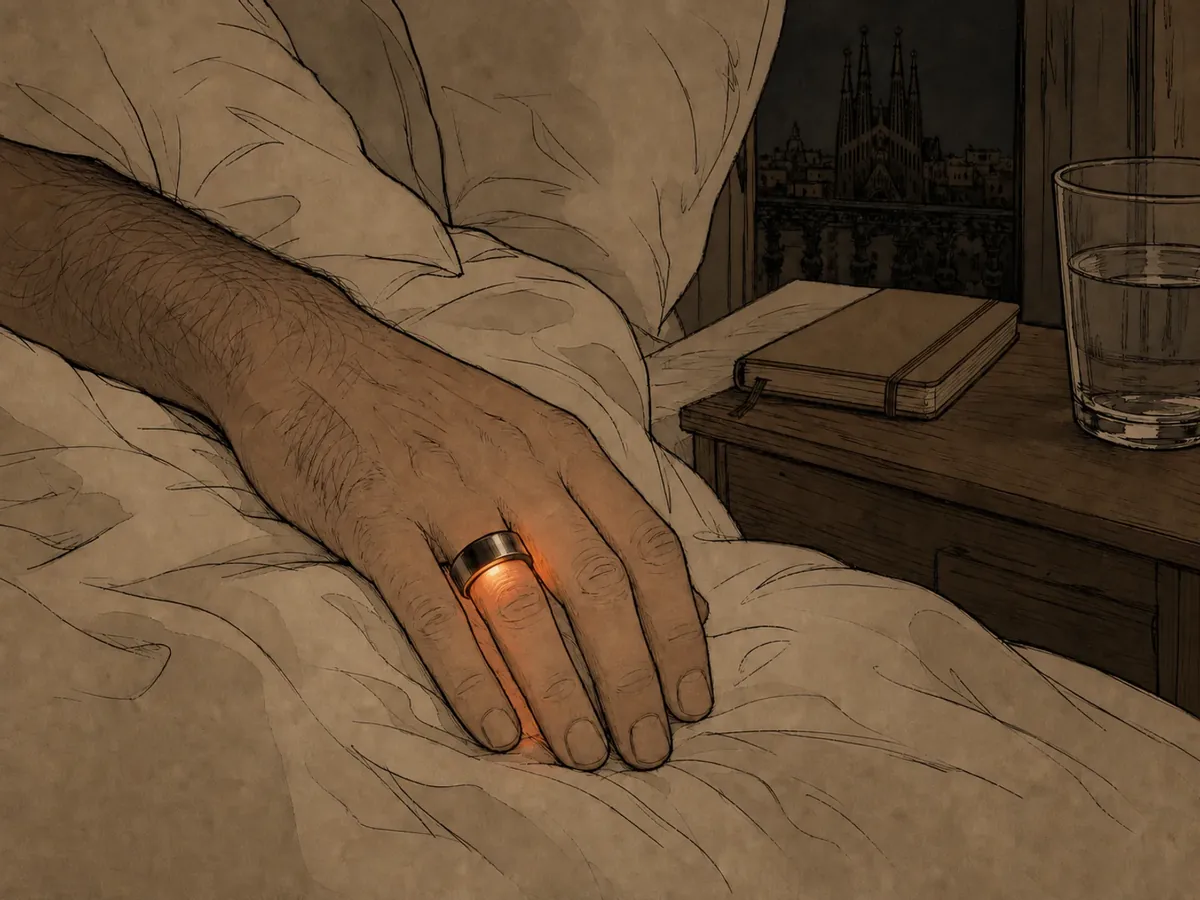
The other thing that got me was the light. It’s bright. You’re lying in bed in the dark and there’s this little beacon on your finger, glowing on and off throughout the night. It made me feel like some sort of semi-cyborg. Cool in the right setting, but not really the vibe you want at eleven at night when you’re trying to switch off.
Would I recommend one?
Not to everyone. If it helps someone build a positive habit, going to bed earlier, taking recovery seriously, noticing a pattern they'd otherwise miss, then it's doing real work and I'm fully behind that. But I wouldn't push it on someone who doesn't already feel a gap it needs to fill. For me, it mostly filled a gap that wasn't there.
If you're weighing it up, it's worth knowing what you're signing up for. The ring itself costs roughly €350 to €550, depending on the model and finish. On top of that, membership is €5.99 a month or €69.99 a year. Without it, you're left with three daily scores and very little of the insight the ring actually exists to give you. New members get their first month included, then the subscription kicks in. That's worth knowing if it's a gift like mine was. None of that makes it a bad buy. It just means going in with your eyes open.
The wearables question
This might read like I'm against the whole category. I'm not. I love technology, genuinely. I'm borderline obsessed with my workstation, and I can't get enough of what AI can do. What I don't love is hardware trying to tell me how to feel or how hard to push, when I've already got a decent read on that myself.
For someone who already struggles with sleep, I think a ring like this can tip into being an overhyped anxiety machine. You wake up, check a score, and the score decides your mood before you've even got out of bed. That's not tuning in, that's handing how you feel over to a number. If you're already anxious about sleep, watching it get measured and marked every night might not be helping.
For someone trying to maximise recovery, an athlete optimising every variable they can control, it's a properly useful tool. I'm just not convinced most of us need to be operating at that level.
My own approach is simpler. I track my training properly, sets, reps, volume, a few notes on how it felt, because that data actually changes what I do in the gym the next session. Beyond that, I ask myself the same questions I'd ask a client. How did you sleep? How's your stress? What's your body telling you? I trust the answer more than I'd trust a graph, because I've spent years learning to read it.
Where I landed
The ring's in a drawer now. I don't wear it, but I'm glad I gave it three months. It told me plenty about how good the technology's got, and it confirmed something I already believed, that the best measure I've got is the one I've spent twenty five years building, my own sense of my own body.
For some people, a ring like this will be the thing that gets them there. For me, it was mostly confirmation I'd already arrived.

Chau for now.
Martin · Barcelona