Check it oot.
Right. School holidays are over, and I won't pretend I love this bit of the year. Going from lazy mornings to a full diary again always takes some readjusting.
With that said, getting back into a routine is a bit like getting back into training. We'll be back in the groove in no time.
One part of my routine rarely changes: my food shopping. I'm nothing if not consistent. What it costs me, however, is another story. I went to restock my whey protein last week and nearly choked when I saw the price.
Audio Issue
The audio version is here to stay. Same as before, you get my glorious Scottish twang reading it to you instead of having to read it yourself. Good for the commute, the dishes, or over a coffee.
The Question
This one's mine, not a client's. I said it out loud while comparing an old HSN order with today's price.
“WTF, whey protein is extortionate. What's going on?!”
It turns out I wasn't being dramatic. So let's look at what's happening, because it's not just me.
European wholesale whey protein concentrate hit €26,450 a tonne in late May 2026. That's more than double what it cost about a year earlier and more than twice the price of copper. At this point, the packet belongs in a safe, not the kitchen cupboard.
In the US, the USDA's figures from the end of April had WPC80 trading between $9.75 and $11 a pound, with isolate firmly in the $12s. Different grades, different currencies, same direction. This has been building for the best part of a year.
Whey supply has one awkward little problem. However much whey the world wants, it can only ever get what cheesemaking leaves behind. The bigger story is protein turning up in everything now, bread, cereal, yoghurt and drinks, not just shakes and bars. Medications such as Ozempic and Wegovy are one part of that demand, not the whole of it. Many people taking them are being recommended protein supplements to help them hold onto muscle while they lose weight. Supply can't scale up quickly. It's limited first by how much milk goes into cheese, then by the filtration and drying capacity needed to turn the leftover whey into powder. Building that capacity takes years, not months.
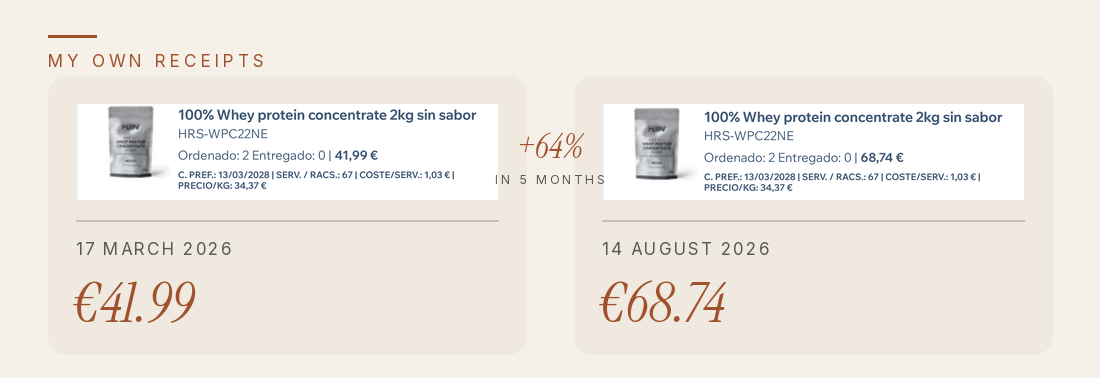
Here are my own receipts, since I've got them. I buy the same packet every time, 100% Whey protein concentrate, 2 kg, unflavoured, the cheapest tier HSN sell, SKU HRS-WPC22NE. On 17 March 2026 it cost me €41.99. On 14 August 2026, same product, same SKU, it cost me €68.74. That's a 64% increase, on one identical item, in under five months.
So what did I do about it? I still bought it. I love whey. Leucine-dense, fast-absorbing, exactly what you want after training, and I'm all about the gains. Soy or a plant blend was never really on the table for me.
What I'd suggest, if the price is starting to sting, have a look at the type of whey you're buying. That packet on my receipt is concentrate, not isolate. I switched once I did the maths, since the extra cost of isolate isn't justified for what you get. Concentrate's been through less filtration, so it keeps a touch more fat, carbohydrate and lactose alongside the protein. Isolate strips more of that out, which is why it costs more and gets marketed as the “premium” option. For most people training for general strength and muscle, that extra filtration buys very little. Isolate's worth it if lactose or digestion is genuinely an issue for you, but otherwise, concentrate's what I'd point most people towards first.
If you want a genuine swap away from whey, soy protein isolate holds up well in the research. A 2018 meta-analysis pooling nine trials found no significant difference in strength or muscle gains between soy and animal protein during resistance training, provided overall protein intake was sufficient. It's often cheaper too, if that's the direction you want to go.
01
Back to it. What your first few weeks might look like.
It might not feel exactly like it used to, and that's fine
Coming back after time off, your first session or two can feel harder than you remember, a bit rusty, some real discomfort. That's normal. It tells you something, just not the whole story, so don't judge where you're at from one session alone.
Cardio often fades faster than strength
This tracks with what we covered in Issue 05. Cardio is often the first thing you notice slipping. Strength tends to hold up better and usually returns sooner.
What your time off looked like matters
Not all breaks are equal. A few weeks of swimming, walking and staying generally active is a very different starting point to an entire summer on the sofa with a spoon in the ice cream tub. Neither is wrong, holidays exist for a reason, but be honest with yourself about which one you had. It changes how much rebuilding you're doing, versus how much is just waking things back up.
Start from where you are, not where you were
If it was simply time off rather than an injury or illness, the approach is broadly the same. Start a notch below what you'd normally do, leave something in the tank, and let your body and mind readapt at their own pace.
One useful judge of whether you've pushed too hard is how you feel a day or two later. If you're moving well and recovering normally, add a bit more next time. If you're still hobbling two days later, ease off before you build again.
02
Coach's Pick: Getting started with meditation
I started meditating after my divorce. It was somewhere safe to disappear into, and for a while I properly did, up to two hours a day. I'd retire to my room at 8pm most nights just to sit. My roommate at the time reckoned I could meditate through anything.
If you're at all interested in meditation, here's how I got started, and two apps I'd genuinely recommend.
I started with Calm. It's got the Daily Calm, ten-minute guided sessions that are an easy way in if you've never sat down to meditate before. There are proper courses if you want to go deeper, bedtime stories, and hands down the best sleep sounds I've ever fallen asleep to. It's on every night in my sleep fortress, and I've never slept better. I even slept like a baby through San Juan.
After a while, two hours a day with no real structure behind it started needing some, so I moved on to Waking Up. Created by Sam Harris, it draws on several Buddhist traditions while remaining deliberately secular. It's more structured and gives you more explanation of what you're doing and why. It also introduced me to Joseph Goldstein, who's since become my favourite teacher. I love him. He's so wise. He's my buddhi. That's what eventually led me to a Buddhist centre myself, where the routine properly settled.
These days it's calmer, literally. Most mornings I do 30 minutes, metta bhavana, mindfulness of breathing or the changing mind, depending on what the day needs, all guided recordings from the London Buddhist Centre. Once or twice a month I go along to a group meditation morning in English at the centre. Sitting in a room full of people doing the same practice is different to doing it alone at home.
Tati's worked out what “you should meditate” really means, coming from her. It means “put one of your three recordings on and let me have a nap.” She's not wrong.
If you've never meditated and don't know where to start, Calm's the easier door in. If you already know it's something you want to stick with, Waking Up is the better next step.
You don't need two hours a day, and that was never really the point. Two hours a day wasn't a goal. It was just where I needed to be at the time. Start with ten minutes and see where it takes you.
Just to be clear, I don't make anything from either of these. I recommend them because I use them myself, not because anyone's paying me to.
One more thing. Issue 05 covered what happens when you take a break from training. This one's the other half, walking back in the door. If you missed it: Time off, pull-ups & Julien's elbow →


Chau for now.
Martin · Barcelona